Featured Research Projects
Distributed Cooperative Data Substrate for Learners in Developing Communities (DCL4D)
Abstract
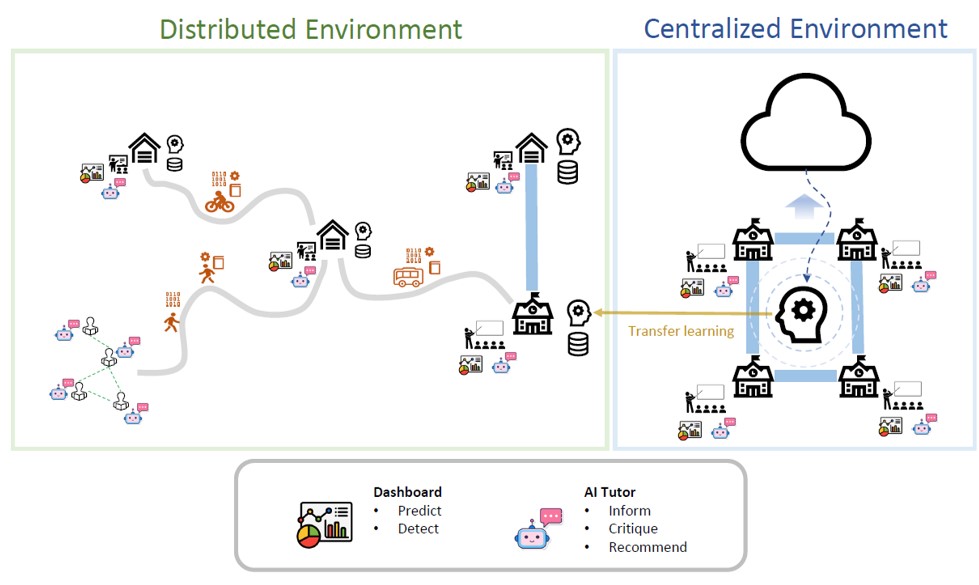
Our recent work in this area includes the design and development of a distributed data sharing environment for people without easy access to the Internet. [more]
Outcomes
Contact: info [at] hdi.ait.kyushu-u.ac.jp>
Knowledge-Aware and LLM-Enhanced Course Recommendation
Abstract
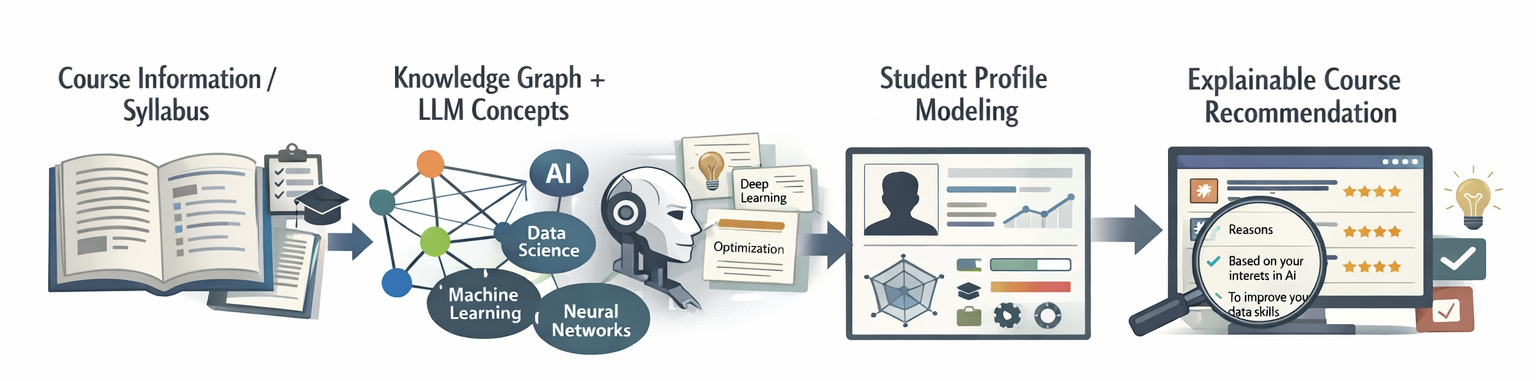
Course recommender systems can help students navigate large course catalogs, but existing methods often rely heavily on historical user–course interactions and black-box representations. This limits transparency, reduces user trust, and makes recommendation quality fragile in sparse or cold-start settings. Our research addresses these challenges through a unified framework for explainable and scalable course recommendation.[more]
First, we study knowledge-aware recommendation models that use structured educational knowledge to build explicit and human-readable user profiles. This line of work improves both recommendation explainability and the interpretation of student preferences. Second, we extend this idea to multi-perspective knowledge modeling, where different semantic relations—such as concepts, instructors, schools, and prerequisite structures—are incorporated to better capture both student interests and course suitability. Third, we investigate how large language models (LLMs) can automatically generate educational resources from course descriptions and syllabi, including course concepts and prerequisite relations, in order to reduce the cost of manual knowledge construction. Finally, we explore how these LLM-generated concepts can be integrated as side information to enhance course representations and improve recommendation performance in a model-agnostic way, especially under sparse-data and cold-start conditions. Overall, this research aims to bridge recommender systems, educational data mining, and human-centered AI by making course recommendation more explainable, robust, and practical for real educational environments. Current ongoing work further explores LLM-based enrichment of both student-side and course-side information for comprehensive data augmentation in educational recommendation.Outcomes
📄 Tianyuan Yang, Ren Baofeng, Chenghao Gu, Feike Xu, Boxuan Ma and Shinichi Konomi, Augmenting Student Profiles and Course Attributes with Large Language Models for Course Recommendation, Int. Conf. Educational Data Mining (EDM2026) (to appear)
📄 Tianyuan Yang, Baofeng Ren, Chenghao Gu, Boxuan Ma, Tianjia He, Shin’ichi Konomi, Towards Better Course Recommendations: Integrating Multi-Perspective Meta-Paths and Knowledge Graphs, Proc. of the 15th Learning Analytics and Knowledge Conference, ACM
📄 Tianyuan Yang, Baofeng Ren, Boxuan Ma, Tianjia He, Chenghao Gu and Shin’ichi Konomi, Boosting Course Recommendation Explainability: A Knowledge Entity-Aware Model using Deep Learning, Proc. of the International Conference on Computers in Education (ICCE 2024), November 2024.
📄 Tianyuan Yang, Baofeng Ren, Chenghao Gu, Tianjia He, Boxuan Ma, and Shin’ichi Konomi, Leveraging LLMs for Automated Extraction and Structuring of Educational Concepts and Relationships, Machine Learning and Knowledge Extraction, 7(3): 103, 2025. https://doi.org/10.3390/make7030103 (Best Paper Award)
📄 Tianyuan Yang, Baofeng Ren, Chenghao Gu, Tianjia He, Boxuan Ma, and Shin’ichi Konomi, Leveraging LLMs for Automated Extraction and Structuring of Educational Concepts and Relationships, Machine Learning and Knowledge Extraction, 7(3): 103, 2025. https://doi.org/10.3390/make7030103
📄 Tianyuan Yang, Baofeng REN, Chenghao GU, Feike XU, Boxuan MA,
Shin’ichi Konomi, Enhancing Course Recommendation with LLM-Generated Concepts: A Unified Framework for Side Information Integration. Big Data and Cognitive Computing (2025).
Contact: yangtianyuan1108 [at] gmail.com
Human-Centered AI Framework for Proactive and Reflective Learning
Abstract
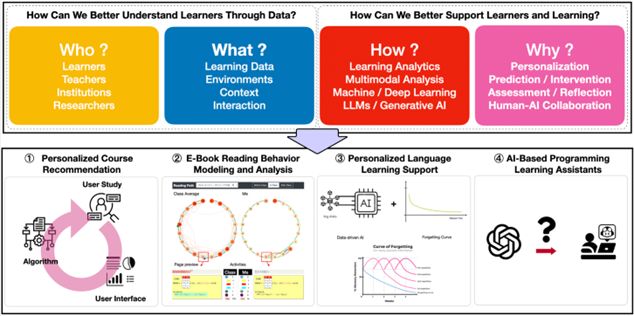
Our research focuses on next-generation AI in education, with particular emphasis on data-driven learning analytics and personalized support systems that enable more adaptive, personalized, and human-centered learning. [more]
This line of research has been guided by two closely connected questions: how can we better understand learners through data, and how can we design AI to better support learning? The long-term goal of this research is to establish a human-centered AI framework for proactive and reflective learning in next-generation education. In this framework, the central challenge is no longer simply how AI can automate educational tasks, but how it can model learners in meaningful ways and provide support that strengthens reflection, self-regulation, and learner agency.① Personalized Course Recommendation. We work on personalized course recommendations in both university and MOOC environments. This line of work included investigating students’ course-choice motivations, developing course-recommendation algorithms, and designing explainable, interactive recommendation interfaces to better support students’ diverse needs and preferences. More recently, this research has expanded to include knowledge-graph- and LLM-based approaches, including the automated extraction and structuring of educational concepts from course materials and the use of large language models for course recommendation tasks.
[1] Boxuan Ma, Min Lu, Yuta Taniguchi, Shin’ichi Konomi. Investigating Course Choice Motivations in University Environments. Smart Learning Environment, Vol. 8, No. 31, Pages 1-18. 2021.
[2] Boxuan Ma, Min Lu, Yuta Taniguchi, Shin’ichi Konomi. CourseQ: The Impact of Visual and Interactive Course Recommendation in University Environments. Research and Practice in Technology Enhanced Learning, Vol. 16, No. 18, Pages 1-24. 2021.
[3] Boxuan Ma, Md Akib Zabed Khan, Tianyuan Yang, Agoritsa Polyzou and Shin’ichi Konomi. Evaluating the Effectiveness of Large Language Models for Course Recommendation Tasks. International Conference on Computers in Education (ICCE 2025), Chennai, India, December 2025.
[4] Tianyuan Yang, Baofeng Ren, Chenghao Gu, Boxuan Ma, Tianjia He and Shin’ichi Konomi. Towards Better Course Recommendations: Integrating Multi-Perspective Meta-Paths and Knowledge Graphs. International Conference on Learning Analytics & Knowledge (LAK25), pp.137–147, Dublin, Ireland, March 2025.
[5] Boxuan Ma, Yuta Taniguchi, Shin’ichi Konomi. Course Recommendation for University Environment. International Conference on Educational Data Mining (EDM 2020), pp. 460-466, Online, July 2020.
② E-book Reading Behavior Modeling and Analysis. We investigate students’ reading processes in e-book environments using data from university courses, including general reading approaches and specific reading behaviors, to understand how learners engage with e-books and how these processes relate to their metacognition and performance. Based on this research, we have also designed intelligent support for e-book learning systems, including personalized navigation recommendations and adaptive dashboards.
[1] Boxuan Ma, Min Lu, Yuta Taniguchi, Shin’ichi Konomi. Exploring Jump Back Behavior Patterns and Reasons in E-book System. Smart Learning Environment, Vol. 9, No. 2, Pages 1-23. 2022.
[2] Boxuan Ma, Li Chen, Xuewang Geng and Masanori Yamada. Understanding Study Approaches in E-Book Logs and Their Relation to Metacognition and Performance. International Conference on Learning Analytics and Knowledge (LAK26), Bergen, Norway, April 2026
[3] Min Lu, Boxuan Ma, Xuewang Geng, and Masanori Yamada. Enhancing E-Book Learning Dashboards with GPT-Assisted Page Grouping and Adaptive Navigation Link Visualization. International Conference on Learning Analytics & Knowledge (LAK25), pp.138–140, Dublin, Ireland, March 2025.
③ Personalized Language Learning Support. We conduct research on personalized language-learning support, including deep-learning-based cognitive-diagnosis models to estimate learners’ language proficiency, knowledge-tracing models to predict memory retention, and spaced-repetition scheduling methods to support long-term retention. These models have been deployed in a widely used language-learning app in Japan and have been used by millions of students, contributing to large-scale learning support.
[1] Boxuan Ma, Sora Fukui, Yuji Ando and Shin’ichi Konomi. Integrating Forgetting Behavior and Linguistic Features in Language Learning Models. ACM Transactions on Knowledge Discovery from Data, Vol. 20, No. 2:19, Pages 1-26. 2026.
[2] Boxuan Ma, Sora Fukui, Yuji Ando and Shin’ichi Konomi. Investigating Concept Definition and Skill Modeling for Cognitive Diagnosis in Language Learning.
Journal of Educational Data Mining (JEDM), Vol. 16, No. 1, Pages 303–329. 2024.
[3] Boxuan Ma, Sora Fukui, Yuji Ando, and Shin’ichi Konomi. Personalized Language Learning Using Spaced Repetition Scheduling. International Conference on Artificial Intelligence in Education (AIED 2025), Palermo, Italy, July 2025.
[4] Boxuan Ma, Gayan Prasad Hettiarachchi, Sora Fukui and Yuji Ando. Exploring the Effectiveness of Vocabulary Proficiency Diagnosis Using Linguistic Concept and Skill Modeling. International Conference on Educational Data Mining (EDM 2023), pp.149–159, Bangalore, India, July 2023.
[5] Boxuan Ma, Gayan Prasad Hettiarachchi, Sora Fukui and Yuji Ando. Each Encounter Counts: Modeling Language Learning and Forgetting. The 13th International Conference on Learning Analytics & Knowledge (LAK23), pp.79–88, Arlington TX, USA, March 2023.
④ AI-based Programming Learning Assistants. We design and develop AI-based programming learning assistants in response to the rapid emergence of generative AI and its growing role in educational practice. This work examines how students interact with AI in programming courses and how AI influences student engagement, problem-solving processes, and learning experiences. It also explores effective ways to integrate AI into computing education by deriving design implications for AI-based programming learning assistants and by developing novel methods and deployable systems that provide actionable yet learning-oriented scaffolding while preserving students’ reasoning and agency.
[1] Boxuan Ma, Li Chen and Shin’ichi Konomi. Examining Student-ChatGPT Interactions in Programming Education. Teaching and Learning in the Generative Artificial Intelligence Age, pp.97–114, 2026.
[2] Boxuan Ma, Liyuan Guo, Tianyuan Yang and Jihong Ding. How Generative AI Impact Student Emotion and Engagement in Programming Tasks? International Conference on Artificial Intelligence in Education (AIED 2025), Palermo, Italy, July 2025.
[3] Boxuan Ma, Li Chen and Shin’ichi Konomi. Enhancing Programming Education with ChatGPT: A Case Study on Student Perceptions and Interactions in a Python Course. International Conference on Artificial Intelligence in Education (AIED 2024), pp.113–126, Recife, Brazil, July 2024.
Contact: boxuan [at] artsci.kyushu-u.ac.jp (web)
Designing Personalized AI Feedback for Student Financial Management
Abstract
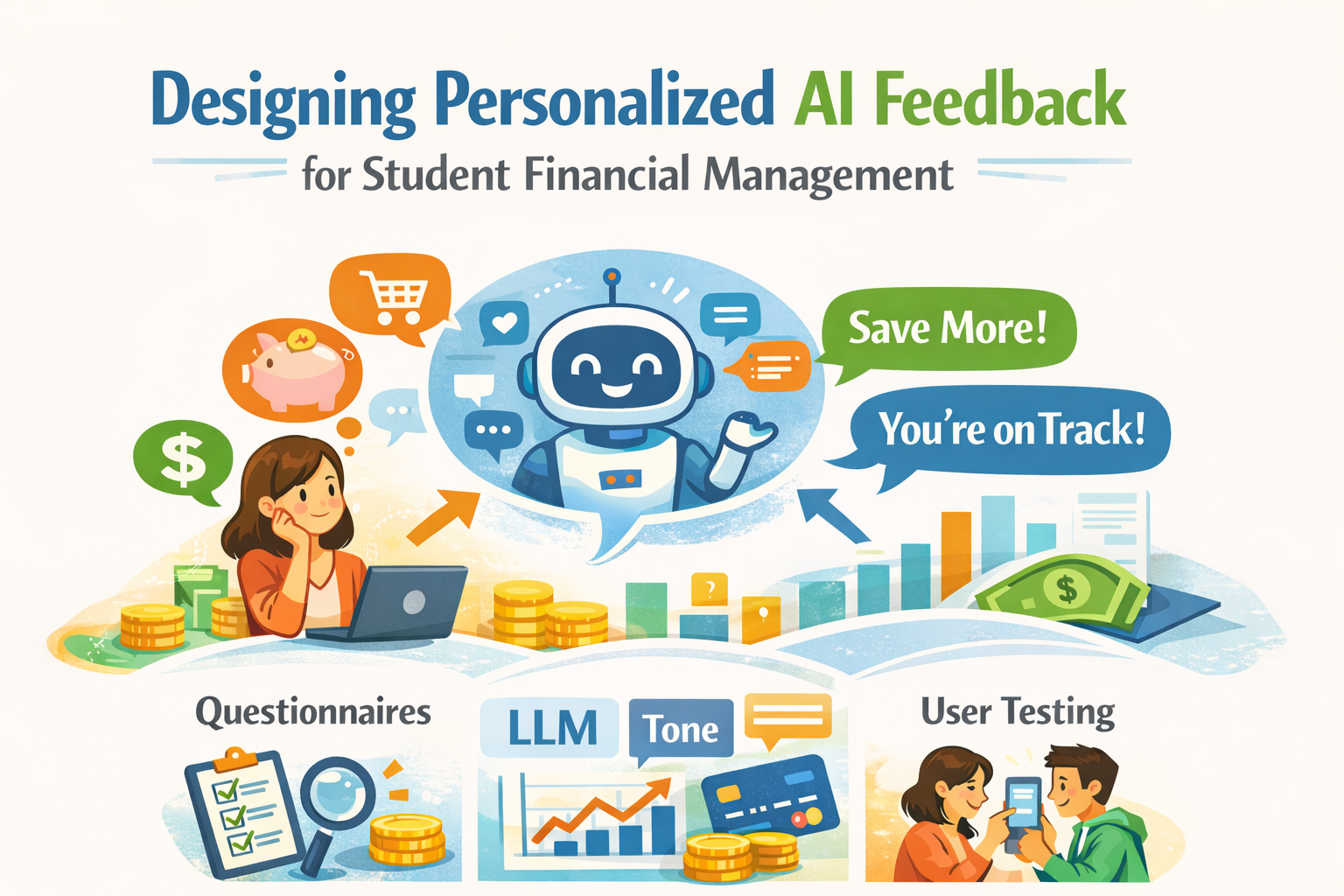
University students face diverse financial challenges in budgeting, saving, spending control, and everyday financial decision-making, yet their needs and motivations vary considerably and existing budgeting tools often provide limited personalization. Our research explores how student financial management can be better supported through human-centered design and AI-based interaction. [more]
Building on earlier work on human-centered AI, financial literacy, and student financial behavior, our current research focuses on designing personalized LLM-based feedback for budgeting support, with particular attention to how different communication tones and styles may better fit different users. Through questionnaire studies, behavioral analysis, and interactive user experiments, this project aims to generate design knowledge for more inclusive, adaptive, and human-centered financial support systems for students.Outcomes
📄 Yinjie Xie, Bouxuan Ma, and Shin’ichi Konomi, Who Budgets and Who Doesn’t? Exploring Student Group Differences to Design Inclusive Budgeting Tools, Poster at ACM/SIGAPP Symp. Applied Computing (SAC 2026), 2026 (to appear)
📄 Yinjie Xie, Shin’ichi Konomi (2024). Developing a Human-Centered AI Environment to Enhance Financial Literacy of College Students: A Systematic Review. Proceedings of the 16th International Conference on Cross-Cultural Design (CCD 2024), Held as Part of HCI International 2024, Washington, DC, USA, June 29-July 4, 2024. Lecture Notes in Computer Science, Springer, Berlin/Heidelberg, June 2024.
Contact: xie.yinjie.786 [at] s.kyushu-u.ac.jp
Sensor-Enabled Speaking-Intention Detection and Adaptive Leadership Support in VR Group Discussions
Abstract
Our research investigates how multimodal sensing and interactive system design can support leaders in VR-based group discussions by making speaking intention more detectable and actionable. [more]
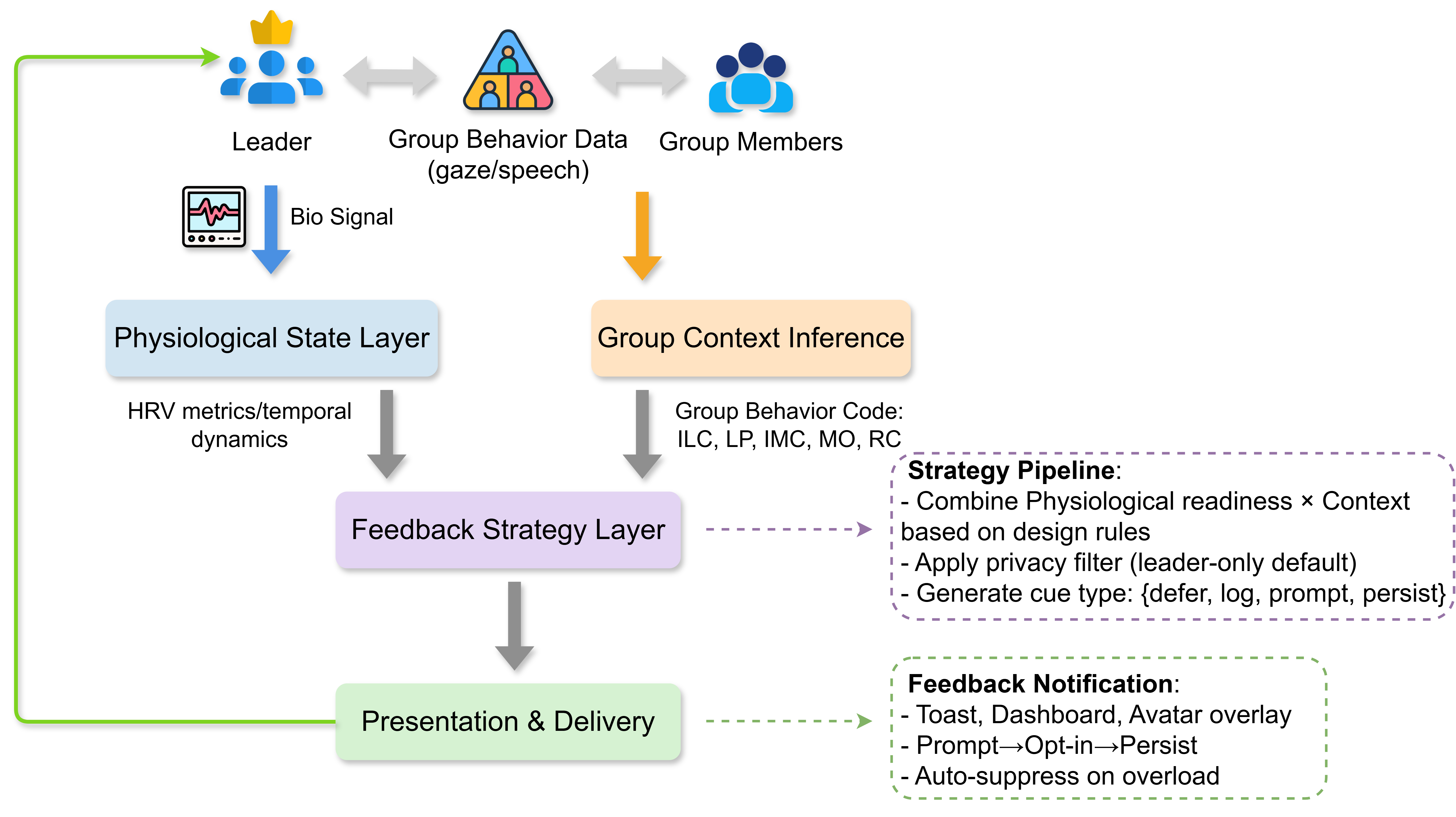
Virtual reality (VR) enables new forms of remote collaboration, but it also reduces many subtle nonverbal cues that people normally use to coordinate turn-taking and participation. This makes it particularly difficult for leaders to notice when group members want to speak, especially when those intentions remain unexpressed. Our research investigates how multimodal sensing and interactive system design can support leaders in VR-based group discussions by making speaking intention more detectable and actionable. This project combines a series of studies on leader-led VR discussions. First, We examined whether sensor data from off-the-shelf VR headsets and controllers can be used to detect suppressed speaking intentions and identify leadership opportunities during group discussions. Next, We extended this line of work by incorporating physiological signals, including ECG-derived measures such as heart rate, heart rate variability, and related temporal dynamics, together with motion features to improve the detection of speaking intention and better capture users’ latent communicative states. Building on these detection results, we further investigated when and how speaking-intention feedback should be delivered to leaders. This included analyzing leaders’ physiological receptivity, group interaction contexts, and preferences regarding feedback attributes such as timing, duration, probability, and anonymity. Overall, this research contributes both algorithmic and design knowledge for leadership support in immersive collaboration. It shows the potential of multimodal sensing for detecting subtle participation cues and provides design implications for context-sensitive feedback systems that help leaders facilitate more balanced, inclusive, and effective discussions in VR.Outcomes
📄 Chenghao Gu, Jiadong Chen, Jiayi Zhang, Tianyuan Yang, Zhankun Liu, Shin’ichi Konomi (2024). Detecting Leadership Opportunities in Group Discussions Using Off-the-shelf VR Headsets, Sensors 2024, 24(8), 2534. https://doi.org/10.3390/s24082534
📄 Jiadong Chen, Chenghao Gu, Jiayi Zhang, Zhankun Liu, and Shin‘ichi Konomi (2024) Sensing the Intentions to Speak in VR Group Discussions, Sensors 2024, 24(2), 362. https://doi.org/10.3390/s24020362
Contact: gu.chenghao.564 [at] s.kyushu-u.ac.jp
Accessible, Informative and Secure Archive of Personal Life Experience

Abstract
We are developing SkyOne, a software system that can input, store, tag, search, and output data such as text, images, audio, and video that contains personal life experience. [more]
We are born with eyes, ears, and sensory nerves that take input from the outside world. Through a long journey of sensing, memorizing incoming data, and actively creating data with voice, pen, brush, camera and keyboard, we become what we call ourselves.
Unfortunately, many of us lack opportunities to record their life experience, letting interesting and unique events or ideas fade over time. Our goal is creating a user-friendly archive system that broadly records human life, which lets us recall memories and discover insights about ourselves and the world, akin to a “second brain”.
In this research, we are developing SkyOne, a software system that can input, store, tag, search, and output data such as text, images, audio, and video that contains personal life experience. In addition, we are designing a mechanism to communicate with local AI models and an interface that allows users to retrieve information in human-accessible format like natural language and visualizations. Since one’s life contains private aspects, the system must strictly enforce data and network security guidelines to ensure the system is trustable and secure for users with or without an information security background.
The end result will be available as open-source software with detailed instructions for users to familiarize and start their daily use. We aim to enable individuals to become aware of their unique capabilities and enhance their memory, decision-making processes and the overall life quality. The outcomes and challenges of this research will be shared to provide references for future researchers.
Outcomes
📄 Meng Te and Shin’ichi Konomi, SkyOne Mirror: A Screenshot-Based Lifelogging and Content Curation Framework for Contextual Recall and Reflection, IEICE-LOIS, May 7-8, 2026 (to appear)
Contact: meng.te.469 [at] s.kyushu-u.ac.jp
Advancing Adaptive Social Exposure Therapy: An Optimized LLM Framework via Elo-Driven Role-Playing and Dynamic Assessment
Abstract
We proposes a Multi-Agent Role-Playing System designed for Adaptive Social Exposure Therapy. [more]
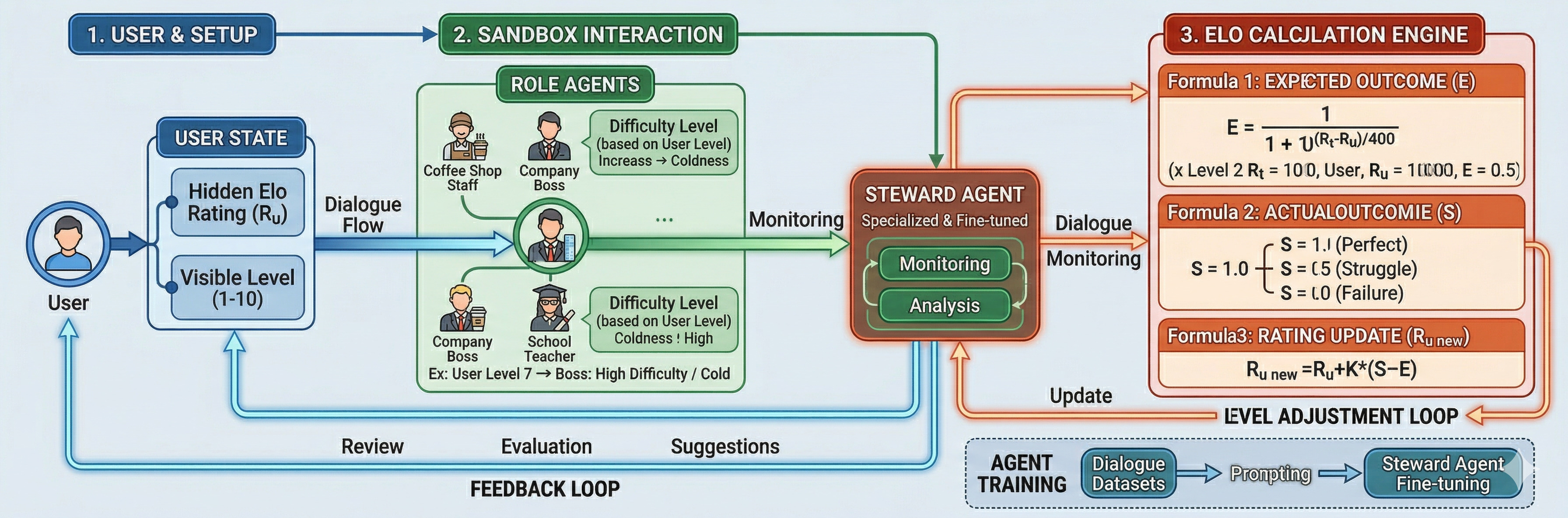
While Large Language Models (LLMs) have shown significant potential in simulating social interactions for social anxiety disorder (SAD) interventions, existing systems often struggle with rigid difficulty settings and lack precise, continuous tracking of user states. To address these limitations, we proposes an enhanced framework: a Multi-Agent Role-Playing System designed for Adaptive Social Exposure Therapy.The core of our system is a multi-agent sandbox that simulates diverse, everyday social scenarios (e.g., interacting with a barista, store owner, corporate boss, or school teacher). To overcome the static nature of traditional prompt-based interactions, we creatively introduce an Elo Rating System borrowed from competitive gaming. This mechanism establishes a hidden score for users, translating into a dynamic level (from 1 to 10). As the user’s level increases, the interacting agents adaptively raise the conversational difficulty—manifested through more indifferent or challenging attitudes.
During these interactions, a dedicated “Butler” (Manager) agent continuously monitors the dialogue. It evaluates the user’s turn-by-turn performance with a granular scoring mechanism combined with the scenario’s baseline difficulty to dynamically update the user’s Elo rating. Furthermore, the Butler agent provides a closed-loop therapeutic experience by offering comprehensive post-interaction debriefings, including targeted evaluations and personalized suggestions. The underlying models are fine-tuned utilizing custom multi-agent dialogue datasets and advanced prompt engineering.
By integrating multi-agent role-playing, Elo-guided dynamic difficulty, and evaluative feedback, this proposed framework aims to provide a highly immersive, scientifically graded, and personalized virtual exposure environment, pushing the boundaries of current LLM-assisted psychological therapies.
Outcomes
- TBA
Contact: dongcy0036 [at] 126.com, chengyedong57 [at] gmail.com